
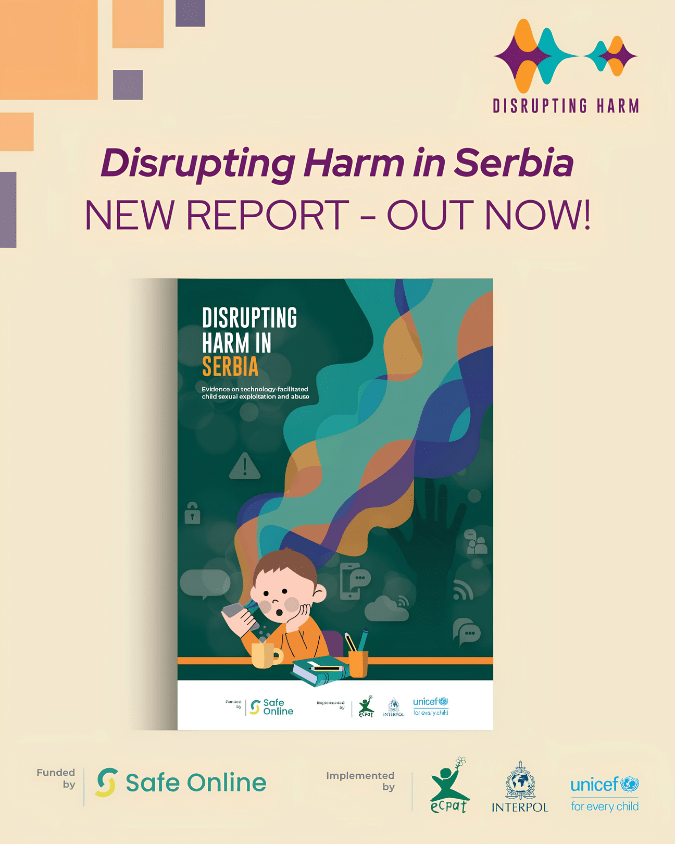
New research from Disrupting Harm in Serbia points to the serious prevalence of technology-facilitated sexual exploitation and abuse of children in Serbia. According to the survey data, one in ten internet-using children aged 12–17 in Serbia was subjected to some form of technology-facilitated sexual exploitation and abuse in the year prior to the survey.
The research was carried out as part of the Disrupting Harm initiative, implemented by ECPAT International, INTERPOL and UNICEF Innocenti – Global Office of Research and Foresight, with support from Safe Online.
The findings show that this is not an isolated “online safety” issue, but a serious child protection concern that requires a coordinated response from the education system, social protection services, justice sector, police, families, civil society and digital platforms.
More than 35% of children who were subjected to technology-facilitated sexual exploitation and abuse experienced more than one form of abuse. The most common forms reported by children included unwanted exposure to sexual images, as well as abusive, exploitative or non-consensual acts involving children’s sexual content. According to the findings, 6% of children reported receiving unwanted sexual content, while 4% said they were asked to share an image or video of their private parts when they did not want to.
The data also highlight the important role of social media and messaging platforms. More than 75% of reported instances of technology-facilitated child sexual exploitation and abuse took place, at least in part, through social media. The most common platforms mentioned were Instagram, followed by Viber, WhatsApp, Snapchat and Facebook.
The research further shows that violence against children in digital spaces is often closely connected to children’s everyday relationships and offline environments. In more than half of the cases, the perpetrator was someone the child already knew, while in one third of cases, children first met the perpetrator at school. These findings challenge the common misconception that the main risk to children comes from strangers online and underline the need for schools, families and communities to be more actively involved in prevention and protection.
Half of surveyed children aged 12–17 reported receiving no sexuality education, formal or informal. The report stresses that education on healthy relationships, consent, boundaries and recognizing harmful behaviour is essential, but must not shift responsibility for protection onto children.
A particularly concerning finding is that children often do not disclose the abuse they experience. Disclosure remains a major challenge: 43% of reported instances were not disclosed to anyone. When children did disclose, they most often turned to friends, followed by mothers or female caregivers.
Formal reporting is also very low. Fewer than 5% of disclosures were made through formal channels such as a social worker, helpline or police. The most common reason for non-disclosure was that children did not think the abuse was serious enough to disclose.
Barriers to disclosure include the belief that the abuse was “not serious enough”, shame, guilt, fear of judgment, fear of parents’ or peers’ reactions, and a lack of understanding of what constitutes abuse, coercion, manipulation or exploitation.
These findings show that children need more than formal reporting mechanisms. They need trusted adults, safe school environments, accessible psychosocial support and clear messages that a child is never to blame for the abuse they experience. Children must be able to seek help without fear, shame or further victimisation.
Full Report is available here.