
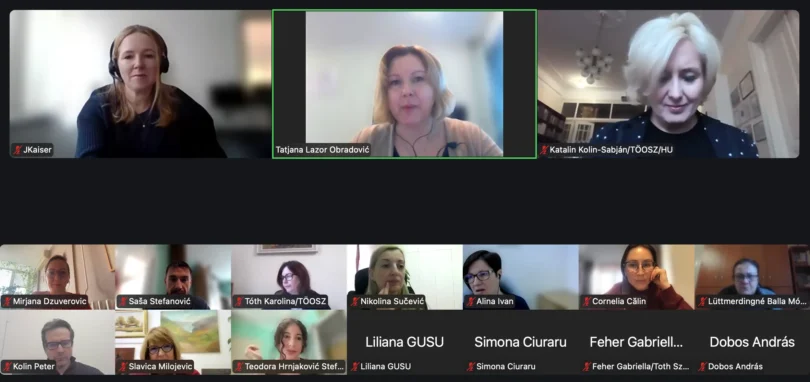
The workshop “Caring Communities in Serbia – Systemic Innovations in Building Sustainable Caring Communities in Serbia” was held on 16 December 2025 via the Zoom platform, within the framework of the Policy Cooperation Platform of the Danube Region for urban and rural actors in the field of home care and community-based services.
The aim of the workshop was to contribute to the development of sustainable and innovative models of community care through the exchange of knowledge, experience, and good practices, with a particular focus on strengthening the home-care system and support for informal carers in Serbia.
The event was opened by Katalin Kolin-Sabján from the Hungarian National Association of Local Authorities (TÖOSZ), who in her introductory address highlighted the importance of regional cooperation in the Danube Region and the role of the Policy Cooperation Platform in advancing home care and community-based services.
At the beginning of the workshop, participants were welcomed by Tatjana Lazor Obradović, a member of the Steering Commitee of the Network of Organisations for Children of Serbia (MODS), who emphasised the importance of developing caring communities, cross-sectoral cooperation, and the role of civil society organisations in improving support systems for the most vulnerable groups.
In the introductory part of the workshop and the first thematic segment, the Laboratory for Systemic Innovations in Serbia was presented by Saša Stefanović, who also introduced a prototype model of long-term care insurance. He underlined the need to establish a sustainable system based on a clear institutional framework, stable financing, and strong cross-sectoral cooperation, with a focus on the user journey through the system and a combination of cash benefits and services.
In the continuation of the programme, Slavica Milojević from the Republic Institute for Social Protection spoke about the service-licensing system in social protection, with a particular focus on the regulatory framework, quality standards, roles and responsibilities of stakeholders, as well as the licensing procedure itself and the process of obtaining a licence to provide services.
The topic of informal carers, their position, key shortcomings in the support system, and possible directions for improvement was addressed by Teodora Hrnjaković Stefanović from the Faculty of Philosophy, University of Novi Sad. She pointed to the scale of unpaid and often invisible care work, gender inequalities in the provision of care, and the need for systemic recognition and support for informal carers.
The workshop was implemented within the project “Caring Communities”, which is carried out with the support of the Interreg Danube Region Programme and brings together partners from nine countries, with the shared goal of improving home care and community-based services.